
Introduction
The GCC healthcare and life sciences market is often viewed through extremes. Depending on who you speak to, the region is either positioned as the next major frontier for growth or as a market defined by complexity and uncertainty. In our experience, neither view fully reflects the reality. At Nuvantta, we regularly speak with healthcare and life sciences companies evaluating or looking to enter the region. Across these conversations, one thing has become increasingly clear:
What companies expect from the GCC can be very different from what it takes to succeed here.
This gap has become more visible as global interest in the region has accelerated. Healthcare transformation programmes, localisation agendas, investment in domestic capabilities and broader economic reforms have created genuine opportunities for international companies. They have also contributed to expectations that do not always reflect how GCC markets operate in practice. Below are five misconceptions we repeatedly encounter when speaking with healthcare and life sciences companies considering GCC market entry.
Misconception 1: The GCC is a Single Market
One of the most common mistakes companies make when evaluating the region is treating the GCC as a single commercial market. The six countries operate distinct healthcare systems, with differences in regulation, procurement, reimbursement, healthcare delivery and disease burden. Saudi Arabia and the UAE illustrate how significant these differences can be.
Comparative Analysis of Health System Structures – UAE and KSA
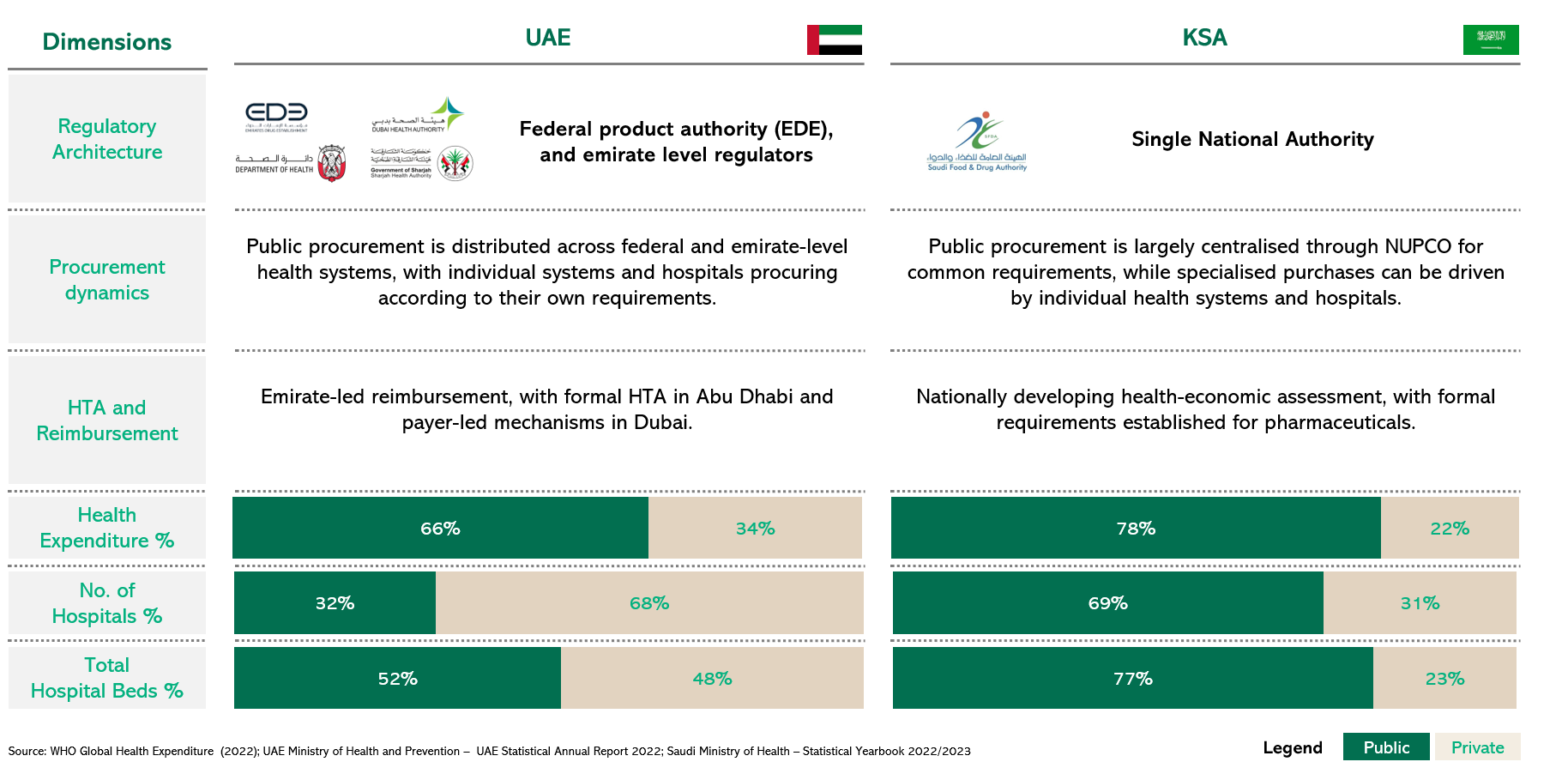
The comparison above shows how quickly the assumption of a regional strategy can become misleading:
-
A. Saudi Arabia concentrates scale and buyer power:
Saudi Arabia has a predominantly government-led provider base, with around 70% of hospitals and 78% of hospital beds in the public sector, while NUPCO consolidates a significant share of public-sector procurement. The larger role of government in healthcare expenditure and delivery concentrates significant purchasing volumes across fewer channels. This can provide a more direct route to scale, but also increases competition around pricing, specifications and access. For newer technologies, procurement alone does not create adoption. Companies still need to build clinical demand within hospitals and specialties before that demand can translate into larger procurement volumes. -
B. The UAE offers greater flexibility for route to scale:
The UAE operates differently, with 68% of hospitals in the private sector and hospital beds more evenly split between public and private providers. Procurement is also more distributed across federal and emirate-level health systems, hospital groups and individual institutions. This creates more opportunities to establish adoption through individual hospitals, provider groups and specialties. With a greater share of healthcare expenditure sitting outside government, reimbursement, provider economics and pricing also become more influential. Companies can be more selective in establishing initial adoption, but scaling often requires that success to be replicated across multiple buyers.
Misconception 2: Appointing a Distributor Means You Have Entered the Market
The GCC remains a largely import-driven healthcare and life sciences market and, naturally, working through a local distributor is the preferred route for many international companies entering the region. The reasoning is understandable. Established distributors already have the infrastructure, market knowledge and relationships that can take years for an international company to develop. They understand local regulatory processes, procurement and healthcare institutions.
The problem starts when appointing a distributor is treated as achieving market entry. Once the objective becomes finding a distributor, companies can move too quickly from identifying potential partners to appointing one, without doing enough diligence on whether that distributor is actually suited to the product and the market it needs to reach. This can create problems in several ways:
-
A. Distributor priorities may not match manufacturer priorities:
Established distributors can represent multiple agencies and large product portfolios, all competing for the same sales teams, technical resources and management attention. Revenue potential, margins, expected volumes and the effort required to develop a product will influence where it sits within those priorities. Entering the GCC may be strategically important for the manufacturer, while its product may remain relatively small for the distributor. -
B. Market coverage does not necessarily mean relevant market access:
A distributor may have extensive hospital relationships but limited depth within the specialties, institutions or procurement channels that matter for a particular product. A specialised device may depend on a small group of physicians and technical support capabilities, while an IVD product may depend on laboratory networks and diagnostic procurement. Distributor fit therefore needs to be assessed against where and how the product will actually be adopted and purchased. -
C. The commercial structure may not create the right incentives:
Even with the right distributor, how the relationship is structured can determine how much effort goes into developing the product. Exclusivity, margins, sales targets, minimum purchase commitments, resource commitments and performance expectations can all influence distributor behaviour. If these are poorly structured, a manufacturer can become dependent on an exclusive partner that has limited incentive to prioritise the product or invest in building the market.
Misconception 3: Commercial Access Is Enough to Build the Market
The GCC has a dense calendar of healthcare exhibitions and industry events, giving international companies relatively easy access to distributors, hospital groups, government stakeholders and potential partners. Naturally, much of the initial market-development effort tends to concentrate around these forums.
What is often underused is the region’s medical conference and specialist society ecosystem. For clinically driven products, these forums provide access to the physicians, KOLs, investigators and specialist centres that ultimately influence adoption. They also help companies understand how patients are treated, what evidence matters locally and where opportunities for education, pilots or clinical collaboration may exist.
Where this engagement does take place, it is also often led primarily through the distributor. That can provide useful access, but leaves the manufacturer dependent on the distributor’s relationships and interpretation of the market. For companies seeking to build a meaningful regional position, direct relationships with the relevant medical community need to develop alongside the commercial channel.
Misconception 4: The Availability of Capital Makes the GCC an Easier Place to Raise
The GCC is home to some of the world’s largest pools of capital, which has naturally attracted international healthcare and life sciences companies looking for funding. However, the amount of capital in the region can create a misleading impression of how easy it is to access. Raising can take longer than companies expect, particularly in biotechnology and sophisticated medical technologies, where the investment ecosystem is still developing. We repeatedly see three assumptions shape how international companies approach the region for capital:
-
A. “There is significant capital moving into healthcare, so the investor pool must be large”:
Government investment across the GCC has increased significantly, particularly towards building domestic capabilities, infrastructure and ecosystems in biotechnology and advanced healthcare. Much of this investment is directed towards developing the region itself, including the infrastructure and capabilities required to attract and support companies establishing locally. The private investment landscape is at a different stage. Health-tech and digital health have a more established investor base, while specialist investment in biotechnology and sophisticated medical technologies is relatively newer. The pool narrows further for companies that require investors comfortable assessing scientific, clinical and regulatory risk over longer development timelines. The amount of capital in the region is therefore very different from the amount of capital relevant and accessible to a particular company. -
B. “It is easier to raise in the GCC than in the US or Europe”:
We have seen international companies approach the GCC primarily for funding, without a specific commercial or strategic reason to establish in the region. The assumption is that the availability of capital makes raising from regional investors easier than competing for funding in the US or Europe. However, GCC investors already have access to global investment opportunities. Large institutional investors invest directly and through international funds, while family offices and private investors allocate capital across global public and private markets. A US or European biotech or medical technology company is therefore still competing against a broad range of global opportunities for capital. Hence, the company still needs an investment case strong enough to compete for that capital. -
C. “Fund us and we will establish in the GCC”:
A different approach is taken by companies that explicitly connect fundraising with plans to establish in the region. We have seen companies approach GCC investors with proposals to build local R&D, clinical programmes, manufacturing or commercial capabilities, but make those commitments conditional on securing regional capital first. This sequencing can weaken the proposition. If establishing in the GCC forms part of the reason a regional investor should invest, the company needs to demonstrate that the regional case has already been developed beyond an intention. This does not require significant capital expenditure upfront. It can include substantive discussions with local institutions, clinical or research partnerships, market validation, MoUs that are progressing towards execution, or management time and resources already committed to the region. Companies asking investors to back a GCC strategy need to show some evidence that they are prepared to invest in that strategy themselves.
Misconception 5: Regional Uncertainty Means Companies Should Wait Before Entering the GCC
The current geopolitical environment has understandably caused some international companies to delay or reconsider their GCC plans. Regional financial markets continue to react to uncertainty around the conflict, while shipping through the Strait of Hormuz remains disrupted. For companies already uncertain about entering the region, this can make waiting until conditions stabilise appear to be the safer option.
The difficulty is that market entry takes time, and many of the foundations can be built before a company commits significant capital or launches commercially. Saudi Arabia continues to pursue its National Biotechnology Strategy, while the UAE continues to invest in advanced clinical research and life sciences capabilities. The longer-term development of healthcare and life sciences across both markets has continued despite the immediate disruption.
-
A. Market preparation does not require immediate market entry:
Companies can use this period to assess which GCC markets are relevant for their product, understand regulatory and reimbursement pathways, map the institutions and clinical communities that influence adoption, evaluate potential distributors and begin developing relationships on the ground. For companies with more complex technologies, this can also include understanding IP requirements, potential clinical or research partnerships and what capabilities would eventually need to be established locally. Much of this work needs to happen regardless of when the eventual commercial decision is made. Delaying a launch may therefore be reasonable, while delaying the work required to understand the market can simply push the entry timeline further out. -
B. Lower activity can provide more time to make the right decisions:
There is a practical advantage to doing this work when there is less pressure to move quickly. Many of the misconceptions discussed throughout this article arise when companies compress market entry into a series of immediate decisions: selecting a market without understanding how its healthcare system operates, appointing a distributor before defining what the product requires, relying on conferences without building the underlying clinical relationships, or approaching the region for capital before developing the investment case. Using the period before entry to work through those questions gives companies a clearer basis for deciding whether to enter, where to enter and what needs to be in place before they do.
Final Thoughts
The misconceptions discussed throughout this article share a common underlying tendency: companies often look for the quickest route into the GCC. A regional strategy can replace country-level analysis, appointing a distributor can be treated as market entry, conferences can become a proxy for building clinical relationships, and the availability of capital can create expectations of easier access to funding.
Healthcare and life sciences markets across the GCC require greater commitment than these approaches suggest. Relationships influence how companies build clinical support, develop distribution, access institutions and establish credibility with investors and partners. Those relationships take time, particularly for international companies entering the region without an established presence or track record.
Commitment does not necessarily require significant capital investment or a large local operation from the outset. Companies demonstrate commitment by spending time in the market, understanding how individual healthcare systems operate, building the right relationships and following through consistently. Trust develops through that process and becomes particularly important where adoption depends on multiple clinical, commercial and institutional stakeholders.
The GCC should be approached with the same rigour as any other important international market. Companies willing to understand each market on its own terms and build credibility over time will have a stronger foundation for long-term growth in the region.